
The choice of a wood cleaner primarily depends on the finish applied to the surface. A varnished parquet floor, a waxed piece of furniture, and a saturated terrace do not react to the same cleaning agents. Confusing these scenarios compromises the existing protection and can even degrade the wood deeply. Here, we detail the technical criteria that truly guide the selection of an appropriate product.
Compatibility between wood cleaner and type of finish
A cleaner formulated for varnished wood generally contains mild surfactants and a neutral pH, designed not to attack the varnish film. Applying the same product to oiled wood has no significant cleaning effect, as the oil penetrates the fibers without forming a surface film.
For a waxed piece of furniture, the logic is reversed. Water-based cleaners dilute the wax and leave the wood unprotected. In this case, we recommend maintenance with liquid beeswax, which cleans and re-protects in one go. The O’Cedar Liquid Beeswax product exemplifies this principle: it combines gentle cleaning and shine enhancement without excessive rubbing.
For raw or sanded wood, the margin for maneuver is even narrower. Excess water causes the fibers to swell and raises the grain. On this type of surface, a barely damp cloth combined with a very diluted black soap remains the safest method. You will also find MetamorpHouse’s wood tips that delve into the distinctions between solid wood, veneer, and laminate.
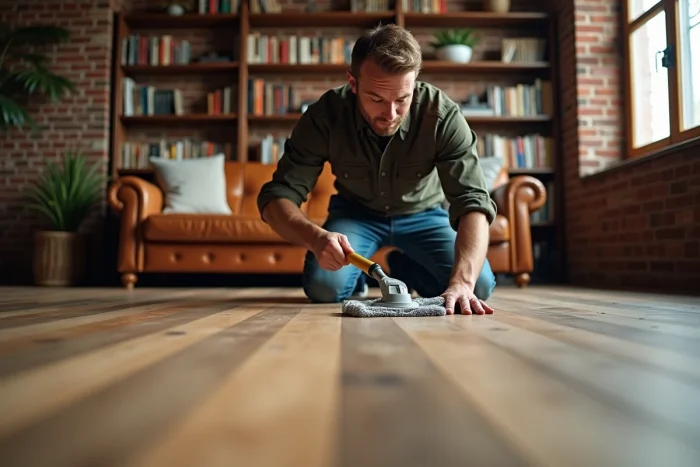
Wood terrace cleaner: the maintenance chain of cleaner, brightener, and saturator
Outdoor wood maintenance is not limited to the choice of a single product. Recent technical guides converge towards a triptych that has become almost normative: cleaner, brightener, then saturator. Treating a terrace with just a cleaner without subsequently applying a saturator means leaving the wood exposed to UV rays and moisture.
Cleaner and brightener: two distinct functions
The cleaner removes organic dirt (moss, food stains, pollution). The brightener, on the other hand, contains an oxidizing agent (often oxalic acid or sodium percarbonate) that restores the original color by dissolving the gray patina formed by UV rays.
Applying a brightener to simply dirty wood is unnecessary and aggressive. The correct sequence is:
- Spring cleaning with a product suitable for outdoor woods, applied with a brush, without a pressure washer
- Brightening only if the wood has turned gray, respecting the application time indicated by the manufacturer
- Application of a saturator at the end of spring, on clean and dry wood, to restore protection against UV rays and water
Pressure washer: an underestimated risk
The high-pressure jet tears out the soft fibers of the wood and creates micro-grooves that retain water. Even devices with a “wood mode” exert enough pressure to damage soft woods like pine or douglas. A brush with a suitable cleaner produces a more uniform result and preserves the longevity of the terrace.
Bio-based surfactants and environmental labels for wood cleaners
In recent years, manufacturers have been positioning cleaners based on plant-derived surfactants, claiming compatibility with sustainable forest management certifications (FSC, PEFC). This trend remains little visible in general comparisons, which focus on immediate effectiveness without examining the composition.
The All Natural Wood Cleaner from Rubio Monocoat illustrates this approach. Positioned as entirely natural, it offers gentle and economical cleaning. Its technical interest lies in its formulation without petrochemical solvents, which avoids degrading finishes based on natural oil (a common problem with conventional cleaners).
We observe that the mention “natural” on a bottle does not guarantee compatibility with all finishes. An alkaline bio-based cleaner remains aggressive for wax. Reading the pH and the technical data sheet of the product takes precedence over marketing claims.
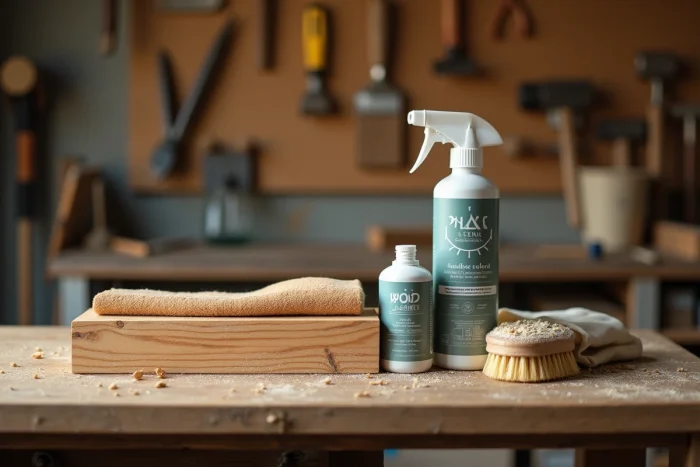
Technical criteria for choosing a wood cleaner suitable for your use
The majority of maintenance errors stem from a poor match between the product and the surface. Three parameters effectively filter the available references.
- The pH of the product: a neutral cleaner (pH close to 7) is suitable for varnished and laminated woods. Slightly alkaline formulas are reserved for raw woods or heavily soiled terraces
- The presence or absence of solvent: solvent-free cleaners preserve oil finishes, while solvent-based formulations gradually strip protective layers
- The mode of application: a ready-to-use spray product is suitable for a small piece of furniture or parquet. For a terrace, a concentrate diluted in a bucket remains more economical and covers large areas without overconsumption
STARWAX Gentle Cleaner for Parquets and Laminates and SPADO Parquet Cleaner are among the most cited references for indoor floors. Both adopt a gentle formula, with no rinsing required, and provide shine. The difference lies in the claimed compatibility: STARWAX also targets laminates, while SPADO covers varnished, waxed, oiled, and varnished parquets.
The right wood cleaner is not the most versatile or the best-selling. It is the one whose pH, chemical base, and mode of application exactly match the finish of your surface. A poorly chosen product does not just clean poorly: it weakens the wood’s protection and shortens the time between two complete renovations.