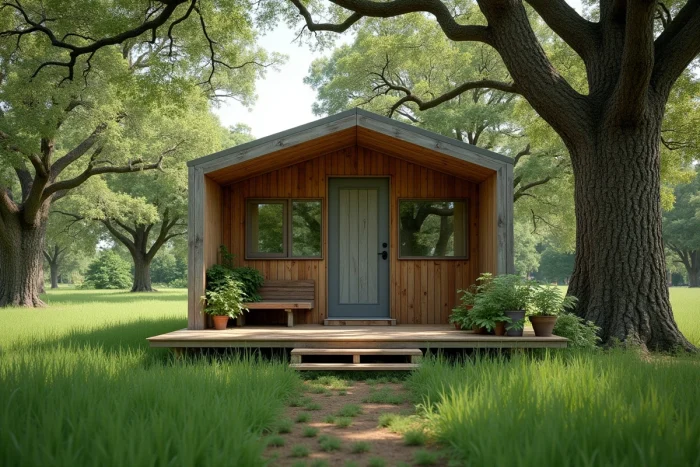
Building a small ecological house requires precisely measuring what each technical choice costs in terms of energy, carbon, and comfort. Between wood frame, prefabricated modular, and bio-sourced masonry, the performance gaps are not trivial. This article compares the main construction and layout options for a small living space, based on the requirements of RE2020 and available field feedback.
Compactness and thermal performance of a small ecological house
Compactness is the most underestimated parameter in a small house project. The more favorable the ratio between the living volume and the outer envelope surface, the less heat loss impacts energy consumption.
Field feedback on wooden houses of around 40 to 50 m², well-oriented and highly insulated, shows that they more easily achieve the performance levels required by RE2020, including summer comfort and limiting overheating, without resorting to air conditioning. The condition: take care of solar protections and natural ventilation.
A documented project on https://www.notrepetitemaison.fr/ illustrates this logic where reducing surface area is not a compromise but a lever for overall performance.
On the other hand, a poorly oriented or under-insulated small space concentrates the flaws: rapid overheating in summer, discomfort amplified by the small volume of indoor air. The choice of land and the orientation of the main facade condition everything else.
Wood frame, modular, masonry: comparison of ecological construction methods
Three methods dominate ecological small house projects. Their differences lie in carbon footprint, construction duration, and level of integrated insulation.
| Criterion | Wood frame (on-site) | Prefabricated modular | Bio-sourced masonry |
|---|---|---|---|
| Construction carbon footprint | Low (carbon storage in wood) | Low (wood + integrated bio-sourced insulations) | Medium (depends on the binder used) |
| On-site construction duration | Several months | Significantly reduced (module assembly) | Several months |
| Waste control | Variable depending on the site | Optimized in the workshop | Variable depending on the site |
| Integrated insulation | To be installed on-site | Panels, joinery already installed in the factory | To be completed (coating, lining) |
| Scalability (future extension) | Good | Very good (addition of module) | Medium (heavy work) |
The ecological modular houses prefabricated in the workshop reduce on-site construction duration, limit construction nuisances, and allow for better control of material consumption. High-performance insulation (wood panels, bio-sourced insulations, joinery) is integrated from the manufacturing stage.
The classic wood frame remains the most widespread method for small formats. It offers good architectural flexibility and a low carbon impact thanks to carbon storage in the structure. In contrast, bio-sourced masonry (hemp concrete, adobe brick) requires more labor and a longer drying time, which increases the overall project duration.
Designing a scalable small house: networks and foundations sized from the start
Building small does not mean building fixed. More and more ecological small houses are designed from the outset as scalable habitats. The principle: size the networks (plumbing, electricity, ventilation) and foundations to accommodate a wood extension or an additional module without destructive work.
This approach allows starting with a reduced area, suited to the initial budget, and then expanding later while remaining compliant with RE2020 performance. The initial cost increase is limited compared to a complete network overhaul during an unanticipated extension.
- Plan for connections in the peripheral walls for the future connection of a module (electrical conduits, water inlets, ventilation ducts).
- Size the electrical panel and heating system for an area larger than the initial area.
- Choose a construction system compatible with the addition of a volume: wood frame and modular are better suited than traditional masonry.
This strategy also applies to interior layout. A small house gains in comfort when the partitions are not load-bearing, allowing for the redistribution of spaces over time without affecting the structure.

Materials and insulation: the choice that weighs most on the carbon footprint
In a small house, the materials category represents a proportionally larger share of the environmental impact than in a large construction, because the envelope surface relative to the living volume is greater.
Bio-sourced insulations (wood fiber, cellulose wadding, hemp wool) have a significantly lower carbon footprint than synthetic insulations (polystyrene, polyurethane). They also better regulate indoor humidity, a direct asset for comfort in a small volume where water vapor concentrates quickly.
The choice of structural material weighs as much as that of the insulation. Wood stores carbon throughout the building’s lifespan. In contrast, conventional concrete releases a significant amount of CO2 during its production. For a small format, this difference translates into a very marked overall carbon footprint gap proportionally.
- Wood fiber: good thermal lag (summer comfort), suitable for wood frame walls.
- Cellulose wadding: effective in blown insulation (attics, boxes), made from recycled paper.
- Hemp wool: moisture-resistant, locally cultivable, compatible with bio-sourced masonry.
Heating and energy in a small volume
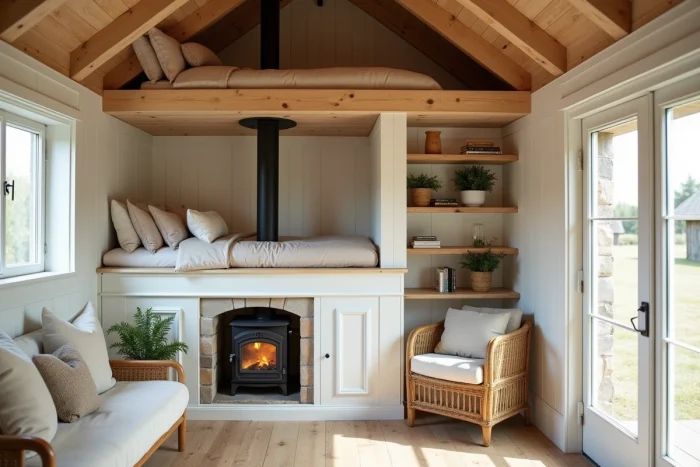
A compact and well-insulated dwelling requires a very low heating power. A wood stove or a small heat pump is often sufficient to meet the needs. The installation of thermal solar panels for hot water complements the system without complicating it.
Controlled mechanical ventilation with double flow recovers the heat from the extracted air to preheat the incoming air. In a small volume, this recovery has a proportionally more significant effect on overall energy consumption.
The last parameter to consider remains electricity production. Photovoltaic panels for self-consumption cover a significant part of a small dwelling’s needs. The most effective strategy combines surface sobriety, bio-sourced insulation, and local energy production, in that order of priority. One square meter not built remains the best gesture for the environment.