
On Monday evening, the fridge contains a bit of vegetables, two cutlets, and a jar of tomato sauce. We fix the phone screen hoping that a meal idea will fall from the sky. This situation is something we almost all experience in a household where the weeks look alike and the menus end up repeating.
Creating varied menus throughout the week requires less inspiration than one might think, as long as you rely on a concrete method and the right tools.
Midweek fridge constraints: the real bottleneck
Planning meals from Sunday works as long as the cupboards are full. By Wednesday or Thursday, fresh products have been consumed, leaving only starches and frozen items.
To avoid this gap, it’s beneficial to split the week into two shopping blocks. A first trip on Saturday or Sunday covers the first three days with fresh products (leafy vegetables, fish, meat). A quick second trip on Wednesday allows for restocking fruits, dairy products, and proteins for the end of the week.
This division changes the game: we no longer try to plan seven dinners at once, but two short sequences. Variety becomes easier to maintain because we adapt the second block to what we actually feel like eating, not what we planned five days earlier. Discover varied menus with myn idee simplifies this organization by offering ideas adjustable to each sequence.
Rotating ingredient families to vary meals
Assigning a theme for each day (Monday = pasta, Tuesday = rice) is a common method. It works for the first two weeks, then we fall back into monotony because the theme always calls for the same recipes.
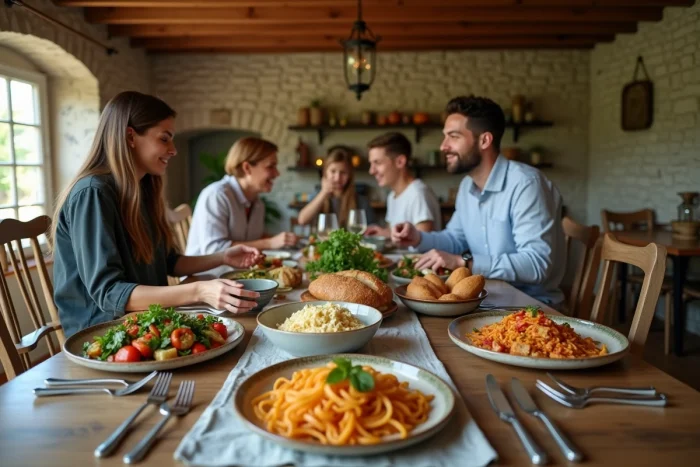
A more sustainable approach is to alternate protein families and cooking methods rather than starches. We think in three simple categories:
- Lean animal proteins (poultry, white fish, eggs) paired with quick cooking methods (pan-frying, steaming, stir-frying).
- Plant-based proteins (lentils, chickpeas, tofu) paired with slow cooking or sauces (stews, curries, gratins).
- “Assembly” meals without long cooking (composed salads, topped bread, bowls) that use leftovers from previous days.
By spreading these three categories over the week (two days of each, plus one free meal on the weekend), we achieve a variety of textures and flavors without thinking recipe by recipe. The rotation focuses on the type of protein, not on the starch, and that’s what prevents monotony.
Myn idee and digital tools to generate meal ideas
Paper charts stuck on the fridge have their limits. We fill them out once, then forget to update them. Recent apps like Saison, Etiquettable, or Kuri allow generating meal suggestions based on the season, the contents of the fridge, and the user’s cooking level.
Myn idee fits into this decision-making support logic. The tool offers dish combinations for the week taking into account what we already have on hand. We save time on the most tedious phase: finding the meal idea, not the recipe itself.
Feedback varies on this point, but most users who maintain regular planning report that the gain lies less in cooking time than in the mental load associated with choice. When the tool suggests three options for Tuesday night, we go from “what are we eating?” to “which of these three options appeals to me?” – a problem much easier to solve.
Eco-score and seasonal dimension
Some digital tools integrate an Eco-score (like OpenFoodFacts) that allows selecting ingredients while limiting their environmental impact. Combining this data with weekly planning naturally pushes towards more plant-based menus and seasonal products, without it becoming a rigid constraint.
The National Nutrition Health Program continues this direction towards fewer ultra-processed products and more plant-based options. Public tools like the Menu Factory from MangerBouger should evolve in this direction, which will strengthen the offer of ready-made menus available for free.
Effective shopping list: the link between menu and budget
A varied menu on paper can blow the budget if the shopping list is not constructed intelligently. The most effective rule we’ve tested: group ingredients by recipe, then merge duplicates.
For example, if Tuesday’s curry and Thursday’s salad both use chickpeas and coriander, we buy once in the appropriate quantity. This merging avoids waste and reduces the bill.
- Write each ingredient next to the corresponding dish, with the approximate quantity.
- Group identical ingredients and adjust the total quantity.
- Identify “pivot” ingredients (onion, garlic, olive oil, lemon) that we buy in larger quantities because they appear in almost every recipe.
- Add one or two “joker” products (cream, grated cheese, soy sauce) that allow for improvisation if a planned meal no longer works.
This method transforms the shopping list into a direct extension of the menu. We no longer buy “just in case”; we buy because a specific dish is waiting for that ingredient.
Adapting the schedule when the week goes off track
A planned menu never survives intact when faced with reality. Unexpected meals out, a sick child, a sudden craving for pizza. Planning two “floating” meals per week absorbs these ups and downs without guilt.
Specifically, we plan five dinners and leave two evenings open. Those evenings are either for using up leftovers or for preparing an ultra-quick meal (omelet, pasta aglio e olio, croque-monsieur). The week’s menu remains a framework, not a fixed program.
When we accept this flexibility, planning lasts over time. Weeks where everything is eaten as planned become a bonus, not the expected norm. It’s this flexibility, combined with a tool like myn idee to spark ideas when inspiration runs low, that makes meal variety sustainable over several months without the burden of planning taking over.