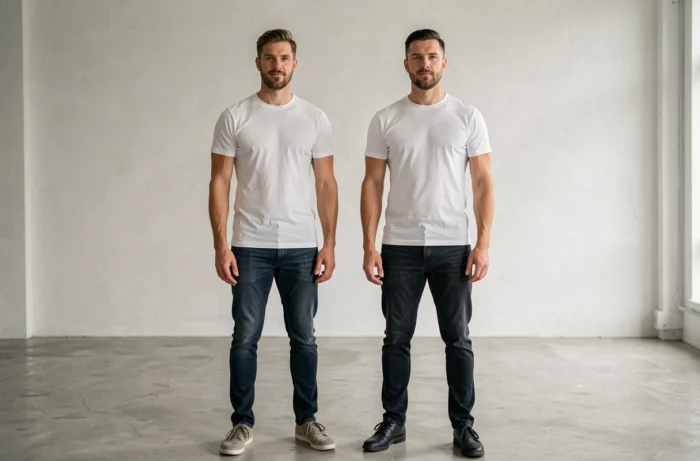
Ten centimeters separate a man who is 1.70m from a man who is 1.80m. On paper, the gap seems modest. In reality, it alters social perception, the relationship with clothing, daily ergonomics, and even certain health indicators. Understanding what this gap entails requires going beyond a simple reading of the tape measure.
Anthropometry and proportions: height does not summarize morphology
Two men measuring 1.80m can have radically different torso/leg ratios. We commonly observe that a man who is 1.70m with a long torso shares the same seated height as a man who is 1.80m whose legs are proportionally longer.
This observation weighs heavily in workplace ergonomics. Adjusting an office chair, positioning a steering wheel, or adapting a kitchen plan relies on the length of body segments, not on the number displayed at the top of the medical column. Recent anthropometric studies confirm this: comfort depends on the intersection of several measurements.
On the clothing side, the difference between 1.70m and 1.80m does not correspond to a simple change in standard size. These ten centimeters redistribute inseam length, sleeve length, and torso height, without necessarily affecting chest circumference. A slim man who is 1.80m can wear size M in width but may need longer cuts. Conversely, a stocky man who is 1.70m will wear size L without ever approaching the “tall” section.

Social perception of male height: the real threshold is not at 1.80m
The social threshold for tall male stature is rather around 1.83m in most Western contexts. At 1.80m, a man remains in an average zone, slightly above. At 1.70m, the perception shifts to “below average.”
The country and generation vary this dividing line. In Nordic countries, 1.80m goes unnoticed. The perception also depends on the immediate surroundings: a man who is 1.80m working with colleagues who are 1.85m gains no perceptual advantage from his height.
Numerical distortion of the gap
On TikTok or Instagram, height comparisons between men accumulate millions of views. The setups (shoes, posture, camera angle) distort the actual reading. Ten centimeters filmed from a low angle seem to be worth twenty. At eye level, they return to what they are: a visible but not spectacular gap.
BMI, weight, and health: the same number, two realities
The body mass index relates weight to the square of height. At the same weight, the BMI of a man who is 1.70m is mechanically higher. A man who is 1.70m weighing 80 kg is classified as overweight according to standard charts, while a man who is 1.80m at the same weight remains within the normal range.
The medical consequences are direct:
- The weight alert threshold is reached more quickly for the man who is 1.70m, whose margin before entering cardiovascular risk categories is reduced
- Basic caloric needs are lower for a stature of 1.70m, making each dietary excess proportionally more costly in terms of weight gain
We recommend never interpreting a BMI without examining the actual body composition (muscle mass, waist circumference, waist/hip ratio). BMI structurally penalizes shorter men, who may display a “borderline” number while being in excellent physical condition.

Average height in France and Europe: repositioning the gap
European averages vary significantly. The Netherlands and Scandinavian countries show higher average statures, which further pushes the perceptual threshold of “tall.” In southern European countries, 1.80m remains perceived as comfortable.
The historical perspective nuances the benchmarks
Two centuries ago, the average male height in Europe was close to 1.70m. The stature considered average today would have been tall in the 19th century. This progression, driven by improvements in nutrition and sanitary conditions, reminds us that social benchmarks around height shift with generations.
Sport and performance: the real influence of ten centimeters
In most team sports, the ten centimeters between 1.70m and 1.80m influence the job profile more than they determine performance level. A more compact build favors a lower center of gravity, which can facilitate quick direction changes. A taller stature, on the other hand, offers an advantage in aerial phases of play.
In weightlifting, the shorter segments of a practitioner who is 1.70m reduce the range of motion on exercises like the bench press or squat. The man who is 1.80m, with longer levers, travels a greater distance to move the same weight. The mechanical advantage is not absolute, but it influences progress on heavy lifts.
The gap between 1.70m and 1.80m affects the relationship to the body, space, and social gaze, without determining everything. Segment proportions, body composition, and cultural context weigh more than the raw number recorded on a height chart.