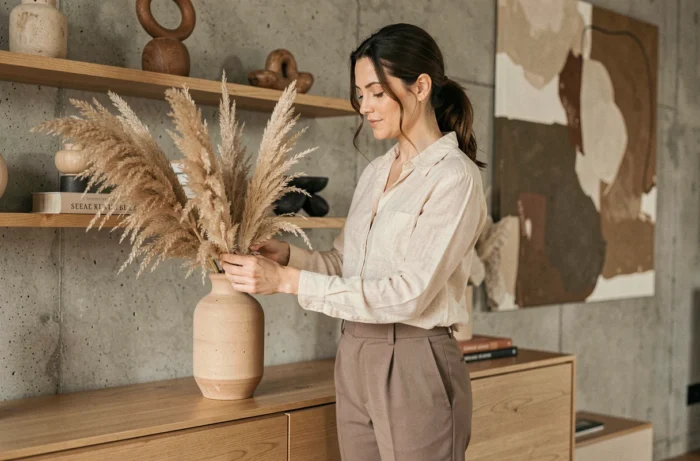
A long-lasting interior relies on precise technical choices, not on an accumulation of trends. Selection of finishes based on their durability, modular arrangement of spaces, traceability of reused materials: modern and personalized interior decoration is built from concrete constraints, not moodboards.
Finishes and Aging: Choosing Surfaces That Last
The choice of a finish is not just a matter of taste. Resistance to abrasion and the ability to age gracefully determine whether a covering will remain presentable after several years of daily use.
Irregular ceramics, for example, better conceal micro-scratches than a rectified tile with a smooth surface. Matte surfaces absorb light differently depending on the angle, visually softening signs of wear. In contrast, a large-format glossy floor reveals every flaw within months in a high-traffic area.
We recommend systematically checking the manufacturer’s technical documentation on abrasion resistance before approving a material. A textile with a documented Martindale rating offers a guarantee that a fabric simply labeled as “natural” does not provide. This approach also applies to wall paints: a matte velvet finish in water-based paint ages better than a cheap satin paint that yellows under UV exposure.
Specialized brands like ego-deco.fr facilitate selection by offering ranges with clearly identified usage characteristics, avoiding unpleasant surprises after installation.
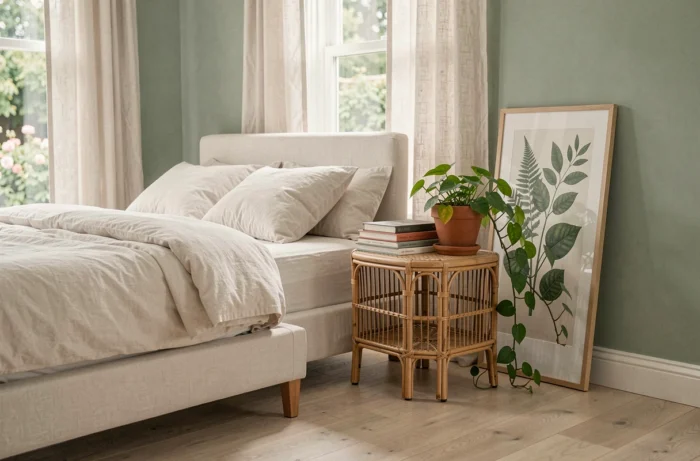
Modular Arrangement: Interior Decoration Designed for Multifunctional Spaces
The unique room dedicated to a single use belongs to a bygone residential model. Multifunctional and reversible spaces respond to real constraints: remote work, intergenerational cohabitation, occasional hosting in a living room that also serves as an office.
Mobile furniture plays a structuring role. A wheeled console, a modular sofa with detachable seats, a table with integrated extensions in a flush top: these pieces allow for reconfiguring a space without heavy intervention. Light separation (wooden screens, thick curtains on recessed rails, open bookshelves back-to-back) replaces fixed partitions.
Selection Criteria for Truly Modular Furniture
- Ensure that the elements can be separated and reassembled without tools, using integrated connectors rather than visible screws that wear out with each handling.
- Favor modules whose dimensions correspond to multiples of a regular step (often based on increments of 40 or 60 cm), facilitating recompositions in different volumes.
- Choose removable covers or washable surfaces on modular seats, a prerequisite for truly versatile use.
The modular arrangement only makes sense if the lighting plan supports reconfigurations. An adjustable lighting rail or repositionable floor lamps are preferable to a central ceiling fixture that freezes the room’s lighting hierarchy.
Reuse and Traceability of Decorative Elements
Reuse in decoration is now a matter of traceability, not just aesthetic preference. The PEMD diagnosis (products, equipment, materials, waste), applicable to deconstruction and renovation projects, requires identifying materials, their assemblies, and their potential for reuse before any integration into a new interior.
Specifically, recovering old flooring or cement tiles from a demolition site requires checking the disassembly of elements without alteration. A cement tile sealed with modern mortar adhesive breaks upon removal. The same tile laid on a lime bed separates cleanly.

What to Check Before Integrating a Reused Element
The origin of the material determines its compatibility with current standards. A vintage light fixture may require electrical compliance. An old solid wood door necessitates a flatness check and adjustment of hinges to contemporary door frame standards.
We observe that the most successful personalized decoration projects integrate a maximum of two or three reused elements per room, positioned as focal points. Beyond that, accumulation creates a thrift shop effect that contradicts the intention of a coherent modern design.
Regionalized Color Palette: Anchoring Colors in the Architectural Context
Personalizing an interior also involves a color anchoring that is coherent with the building. Ocher, burnt earth, and browns work well in areas marked by limestone or facades coated with pigmented lime. Off-whites, bluish grays, and faded blues harmonize with coastal architectures or interiors bathed in cold natural light.
Choosing a palette based on the natural light of the home avoids costly corrections after application. A warm hue applied in a north-facing room appears dull. The same hue in a southwest-facing room takes on an intensity that can visually saturate the space.
- Systematically test paint samples on the relevant wall at three times of the day (morning, noon, evening) for at least 48 hours.
- Match wall colors to existing materials (flooring, woodwork, countertops) rather than to an abstract palette seen on screen.
- Limit the main palette to three shades per room, playing with values (light, medium, dark) rather than multiplying colors.
Modern and personalized interior decoration is not decreed by the addition of decorative objects. It results from technical choices regarding materials, a layout that anticipates real uses, and a palette anchored in the physical context of the home. An interior that ages well is one where every choice has been documented before being installed.