
Making your home sustainable goes beyond just replacing light bulbs or sorting your waste. The rules of the game have changed: since January 1, 2025, homes rated G on the energy performance certificate (DPE) can no longer be rented out. Class F will follow in 2028, and class E in 2034. This regulatory timeline requires measuring the gap between a home’s current state and the targeted performance before choosing any equipment.
Energy Decency Timeline: Deadlines that Condition Renovation
The French regulatory timeline transforms energy renovation into a progressive obligation. Its impact varies according to the DPE class of the home and the owner’s status.
| DPE Class | Rental Ban | Concerned Profile |
|---|---|---|
| G | Since January 1, 2025 | Landlord Owners |
| F | 2028 | Landlord Owners |
| E | 2034 | Landlord Owners |
For an owner-occupier, these deadlines do not impose anything directly. However, they influence the resale value of the property. A home rated F or G loses attractiveness in the real estate market with each passing year without renovation.
This table shows that a planned renovation strategy replaces isolated small gestures. Moving from a class G to a class D or C cannot be achieved by simply installing a connected thermostat: it requires a coordinated set of works.
Resources like lamaisondurable.com help structure this reflection by crossing the technical constraints of the building with available assistance.
Set of Works: Why Insulation Alone is Not Enough for an Ecological Home
Online competitors often detail insulation as the priority action. Recent data nuances this approach. To gain at least two DPE classes (a condition of the supported pathway of MaPrimeRénov’), it is necessary to combine the building envelope, heating system, and ventilation.
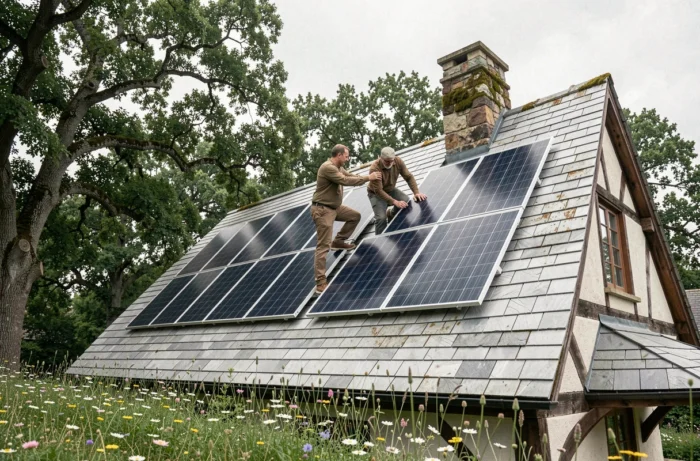
Insulating walls and roofs reduces thermal losses. But if the heating system remains an old boiler or if ventilation is absent, the actual performance gain is capped. The supported pathway of MaPrimeRénov’ also requires a prior energy audit, the use of Mon Accompagnateur Rénov’, and certified RGE companies.
This requirement for coherence among the work items has a direct consequence: the initial budget is higher, but the final result is measurable and sustainable. A home renovated through a set of works achieves a performance level that three successive and unrelated interventions do not reach.
- The envelope (walls, roof, ground floor) addresses the main losses, often responsible for the majority of heat loss.
- Replacing the heating system (heat pump, biomass boiler) adapts heat production to the new needs, reduced after insulation.
- Controlled mechanical ventilation renews the air without wasting the produced heat, a point often neglected in many partial renovations.
Skipping any of these three items means optimizing one link without addressing the chain. The prior energy audit identifies the items to prioritize according to the existing building.
Summer Comfort and Solar Protection: The Overlooked Angle of Ecological Construction
Most guides on sustainable homes focus on winter performance. The increasingly frequent heatwaves in France expose a flaw: a very well-insulated home can become stifling in summer if nothing is planned to limit solar gains and evacuate heat.
Summer comfort requires solar protections, appropriate shading, and effective ventilation. These three elements work together. Roller shutters or adjustable sunshades reduce incoming heat. Vegetation on the south or west facade creates natural shading. Night ventilation (cross or mechanical) evacuates heat accumulated in the walls during the day.

This topic has become a full-fledged real estate criterion. Recent analyses show that climate now enters the criteria for choosing a home, alongside size or location. An apartment under the roof poorly protected from the sun loses in usability value, even if it shows a good winter DPE class.
For new construction, integrating these devices from the design stage costs little. In renovation, joinery and solar protections logically add to the set of works described above.
MaPrimeRénov’ and Financial Aids: What Changes for Sustainable Renovation Projects
The budget of the National Housing Agency has been revised downwards, with a reduction announced of several hundred million euros. This evolution modifies the financial calculation of an ecological renovation project.
The supported pathway of MaPrimeRénov’, which aims for a gain of at least two DPE classes, remains the central mechanism. It conditions assistance on the effective realization of a coherent set of works. Some isolated work projects are gradually excluded from the system, pushing households towards comprehensive renovations.
Access conditions evolve regularly. Before starting a project, checking the current criteria with the ANAH or a France Rénov’ advisor avoids unpleasant surprises. A refusal of the application after the commitment of works remains the most financially penalizing scenario.
- Check the current DPE class of the home through a certified audit before any financial commitment.
- Use Mon Accompagnateur Rénov’ to structure the work pathway and secure the aid application.
- Select RGE companies, a mandatory condition for eligibility for public aid.
- Anticipate regulatory changes (rental ban for class F in 2028) in the project’s timeline.
The ecological lifestyle related to housing does not rely on an accumulation of symbolic gestures. It is built on a precise diagnosis of the building, a coordinated set of works, and consideration of comfort in all seasons. French regulatory deadlines accelerate this transition, whether the home is intended for rental or personal use.