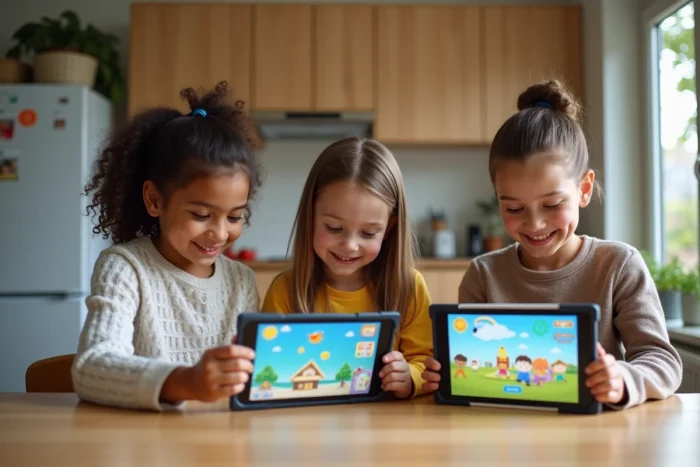
One in three children uses an online educational platform daily, according to the latest estimates from the Ministry of National Education. Official school programs now integrate digital tools from kindergarten, but no strict framework imposes limits on the diversity of resources accessible from home.
Free applications coexist with specialized sites that require a subscription, while digital libraries see their attendance soar as soon as school holidays begin. In the face of this abundance, both parents and teachers constantly juggle to navigate a shifting landscape, where play and learning intersect continuously.
Why diversifying online activities is essential for children’s development
Growing up is about exploring. It’s about multiplying experiences and opening up to new worlds. Well-chosen digital resources then become powerful levers to strengthen academic skills while igniting curiosity, resourcefulness, or imagination. An educational game invites learning through fun, while a pedagogical game targets a specific concept. This nuance sometimes hinges on the adult’s intention who guides, accompanies, and chooses. Parents, babysitters, educators: all play a conductor’s role in this selection.
Research abounds: varying digital activities stimulates children’s autonomy. Transitioning from a math workshop to an interactive book, from a quiz to a video documentary: these are all ways to broaden their horizons. Educational or learning platforms for children do not aim to replace school but to give it new colors. They invite the child to take ownership of knowledge, to question, to experiment.
Vigilance, however, must not wane. Adults must maintain control over the choice of educational resources. Whether free or paid, these tools require vigilance and sorting. Discover Annuaire des Enfants to access a methodical selection of safe sites, suitable for every age, every desire, and every learning need. This directory designed for education guides adults in their search for content that is both relevant and reassuring, for a thoughtful use of digital technology.
Which educational and playful resources to prioritize according to age and interests?
It’s not just about keeping the child occupied, but about nurturing their curiosity, channeling their energy, and accompanying them in their discoveries, through digital resources that align with their age and passions. From kindergarten, it’s better to focus on interactive applications where the child manipulates, experiments, and discovers numbers, letters, or colors. These games, often inspired by active pedagogies like Montessori, also strengthen fine motor skills.
Between ages 2 and 7, platforms offering playful activities around mathematics, reading, or emotions provide a real advantage. The approach should remain light, so as not to stifle natural curiosity. Quizzes, matching games, educational videos: these are all entry points to autonomous and motivating learning.
With primary school, it’s time to diversify further: thematic videos to clarify specific concepts, quizzes to test what has been retained, digital board games to learn to cooperate or solve puzzles. At this age, exploring documentary files, practicing on platforms dedicated to math or languages becomes relevant.
Here are some principles for making good choices:
- For each age group, prioritize educational resources directly related to the child’s interests: animals, science, history, logic, or creativity.
- Adjust the difficulty to maintain attention: neither too simple nor too complex.
Vigilance never fades: the accompanying adult must verify the reliability of the content. Again, Annuaire des Enfants facilitates selection by listing validated educational sites according to each child’s profile and interests.
Concrete ideas to easily integrate these tools into family life
Establishing a structured digital routine is the first step toward a reasoned use of online educational resources. Set short and regular time slots to access educational games, quizzes, or educational videos. This way, the child identifies their reference points, while the parent maintains control over screen time and content.
Pairing each digital session with an offline activity enhances the impact of learning. Here are a few examples:
- Start a quiz about animals, then pull out a board game on the same theme or watch a video about volcanoes before making a model out of modeling clay: this back-and-forth between virtual and real fosters active learning and avoids passivity.
- Parental control remains a pillar: regularly check security settings, educate the child about personal data protection and digital citizenship.
Involving the child in the choice of educational applications develops their autonomy and critical thinking. Alternating between playful content and short training balances discovery and consolidation of knowledge. Finally, some serious games like “Vinz and Lou on the Internet” raise awareness among the youngest about online safety and responsible digital use.
- Involving the child in selecting educational applications strengthens their autonomy and critical thinking.
- Alternating between playful content and short training allows for a balance between discovery and consolidation of knowledge.
- Using serious games like “Vinz and Lou on the Internet” raises awareness among the youngest about online safety and responsible digital use.
When the digital routine naturally integrates into family life, each parent or babysitter becomes an actor in this connected education, ensuring both enjoyment and vigilance. Balance is created, reference points are established, and the child, guided yet free, progresses at their own pace. Screens no longer become a blurry territory, but a controlled stop on the road to knowledge.