
Virginia Henderson’s model is more than a list of fourteen items to tick off on a patient assessment form. It is a clinical reasoning tool that structures observation, guides analysis, and shapes nursing care planning.
Clinical reasoning and fundamental needs: what the checklist doesn’t tell you
Filling in a needs assessment chart is a pointless exercise if the data collected are not verified, interpreted, and then reassessed throughout care. The complete sequence has five steps: observation, identifying the unmet need, analyzing the sources of difficulty, planning the intervention, and evaluating the outcomes.
Too many patient assessments stop at identification. A need is marked as “impaired,” but without analyzing the source of difficulty, no appropriate care can be planned. Virginia Henderson identified three possible causes of dependence: lack of strength (physical or psychological), lack of will, and lack of knowledge. Each calls for a different response.
A patient who has stopped eating because of a loss of appetite linked to depression requires a different care plan from a patient with swallowing difficulties. The checklist identifies the same unmet need (eating and drinking), but the clinical analysis differs radically.
For a closer look at each need and its assessment criteria, Virginia Henderson’s 14 needs is a detailed resource explaining the signs of independence and dependence for each need.
Rating nursing care needs: four levels, one goal
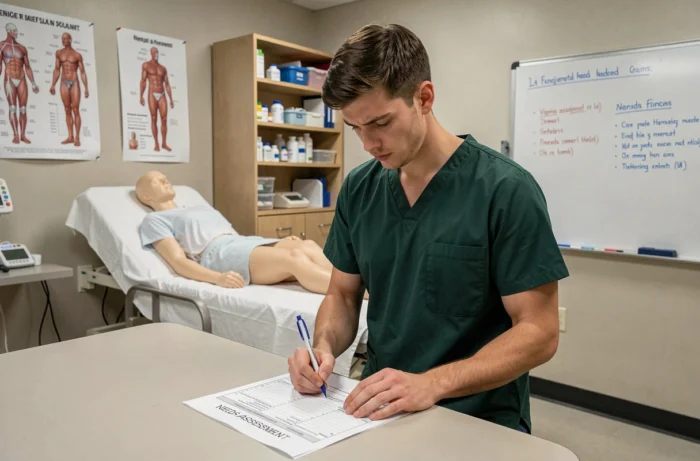
The assessment scale commonly used in nursing and nursing assistant training programs distinguishes four levels: need met, need impaired, need severely impaired, and need critically impaired. Henderson herself did not formalize a numerical scale. This grading system was developed for teaching and interprofessional communication.
Each level reflects a degree of dependence that determines the type of intervention. A need that is met calls for monitoring. An impaired need may require patient education or partial assistance. A critically impaired need requires full assistance, sometimes with technical support (assisted ventilation for the need to breathe, enteral feeding for the need to eat and drink).
Assessment is never static. A post-operative patient may move from a critically impaired need for mobility to a mildly impaired one within a few days, changing the care plan with each reassessment.
Sources of difficulty: the key to the analysis
Rating a need alone is not enough to guide care planning. We recommend systematically identifying the source of difficulty associated with each unmet need:
- Lack of strength: a physical limitation (fatigue, pain, motor disability) or psychological limitation (anxiety, confusion) that prevents the person from acting
- Lack of will: lack of motivation, refusal of care, or disengagement linked to depression or a loss of purpose
- Lack of knowledge: the person does not know how to meet their need, making this a direct focus for patient education
This three-part framework of strength, will, and knowledge remains the foundation of nursing clinical reasoning as Henderson conceived it.
Henderson’s model and other nursing assessment frameworks
Henderson’s model is not the only framework available for structuring a patient assessment. Marjory Gordon’s eleven functional health patterns offer an alternative organized by function (health perception, nutrition-metabolism, elimination, activity-exercise, sleep-rest, cognition-perception, etc.).
The difference in approach is significant. Henderson starts with the person’s autonomy and their ability to meet their needs independently. Gordon organizes assessment by functional domains, taking a more systemic approach that incorporates relational and adaptive dimensions from the outset.
In practice, the two frameworks are not mutually exclusive. Some hospital departments use Henderson for the initial assessment and supplement it with tools from other models in complex situations (psychiatry, palliative care, geriatrics).

Psychosocial needs in nursing care: the most frequently overlooked needs
The nine psychosocial needs are consistently assessed less thoroughly than the five physiological needs. The needs to communicate, practice one’s religion, engage in meaningful activities, or learn are often documented with vague phrases (“need met”) and no real clinical observation.
This gap has direct consequences for care. A long-term hospital patient whose need for recreation and leisure is never assessed may become socially isolated, worsening their dependence in other areas (sleep, nutrition, mobility).
Practical assessment of non-physiological needs
Assessing these needs relies on clinical interviews and behavioral observation, not measurable vital signs. Here are some practical indicators:
- Need to communicate: Does the person initiate conversations? Do they use aids (glasses, hearing aid)? Do they express their emotions?
- Need to learn: Does the patient ask questions about their treatment, condition, or return home?
- Need to engage in meaningful activities: What activities did the person take part in before hospitalization, and which are still possible?
- Need to act according to one’s beliefs: Do religious practices or personal values influence care (food, schedules, rituals)?
An incomplete assessment of psychosocial needs leads to an incomplete care plan. Henderson’s holistic approach loses its meaning if only vital signs and bodily functions are documented.
Virginia Henderson’s model remains relevant as long as it is used as a comprehensive clinical reasoning tool, not an administrative checklist. Every need identified as impaired calls for an identified source of difficulty, a targeted intervention, and reassessment. This rigor in the clinical process is what distinguishes structured nursing care from a simple record of observations.