
The global sustainable clothing market is showing a growth trajectory significantly higher than that of the textile industry as a whole. Estimated at $8.6 billion in 2024 according to Global Market Insights, this segment is expected to reach $43 billion by 2035, with a compound annual growth rate of around 16%.
No institution has set a specific target for the percentage of sustainable clothing sold by 2025. The available data allows for measuring a dynamic, but not yet a stabilized market share.
Environmental penalty in France: the law that changes the price equation
Where most analyses focus on materials or labels, the French regulatory lever directly modifies the cost structure. The text adopted by the National Assembly on March 14, 2024, provides for an environmental penalty that can reach several euros per item for very low-priced and ultra-fast fashion clothing. The measure explicitly targets players like Shein and Temu.
This penalty is accompanied by a ban on advertising for fast fashion products covered by the regulation. The stated goal is not to set a quota for sustainable clothing, but to reduce the price gap between a disposable item and one designed to last. If the implementing decrees follow the legislative timetable, the mechanical effect will be to increase the relative share of sustainable purchases among French consumers.
To better understand the percentage of sustainable clothing in 2025, it is necessary to cross these market projections with the expected effects of this type of regulation, which remains, for now, an isolated French initiative in Europe.

Second-hand and upcycling market: figures that blur the categories
The second-hand market, driven by platforms like Vinted, now represents a transaction volume that significantly impacts shopping habits. The question of whether a resold garment is “sustainable” remains open: a fast fashion item resold three times does not change its textile composition.
Upcycling, which involves transforming an existing garment into a higher-value piece, is progressing in the collections of brands positioned in the ethical niche. However, its weight remains marginal in volume compared to new production. Second-hand increases the lifespan of items without altering their initial production impact.
This distinction has direct consequences for measuring “sustainability”:
- A certified organic cotton garment, produced in a traceable supply chain, clearly falls into the sustainable category from its manufacture.
- A synthetic garment resold on a second-hand platform extends its use but does not reduce the emissions related to its production.
- A piece resulting from upcycling values existing materials, with a near-zero manufacturing carbon impact, but the volumes remain low.
Aggregated data on the “sustainable clothing” market often mix these three realities. Growth projections of around 16% compound annual rate pertain to new sustainable clothing, not second-hand.
Brand transparency: what labels really measure in 2025
Transparency is among the most cited criteria by consumers when describing their expectations regarding ethical fashion. Brands are multiplying dedicated pages to their commitments: traceability of materials, working conditions in factories, carbon footprint per product.
The problem lies in the absence of a unique reference framework. A garment can be certified GOTS (organic cotton), OEKO-TEX (absence of harmful substances), or labeled by a brand-specific initiative. No label alone covers the entire chain, from fiber to transport, including dyeing and social production conditions.
For consumers, this proliferation of labels creates confusion that hinders the shift towards sustainable purchasing. Some sector studies indicate a rise in the willingness to buy ethically, while actual market shares remain modest compared to the overall volume of the textile industry.
Recycled materials and bio-based fibers: where does production stand at scale
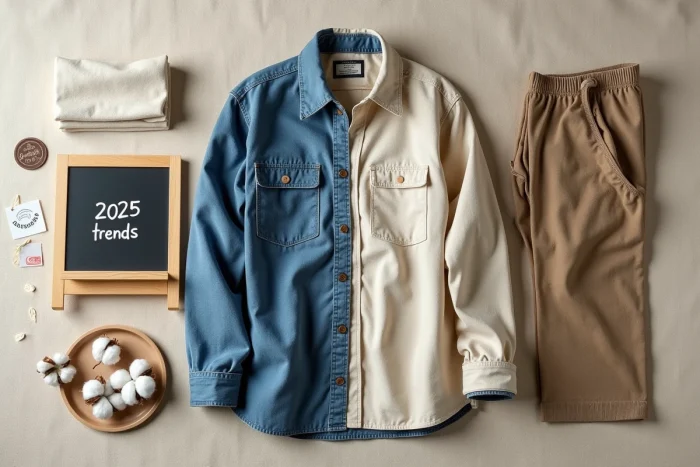
Recycled materials (polyester from plastic bottles, regenerated cotton) and bio-based fibers (plant-based polymers) form the technical foundation of sustainable fashion. Their integration into collections is progressing, but the availability of these raw materials limits scaling up.
Recycled polyester remains the most widely used sustainable fiber by volume. Its production is better controlled than that of recycled cotton, whose regeneration process degrades fiber length and requires mixing with virgin cotton to maintain fabric quality.
Bio-based polymers, made from corn or sugarcane starch, offer an alternative to petroleum derivatives. Their production cost remains higher, and their actual biodegradability depends on industrial composting conditions, which are rarely accessible to the end consumer.
The sustainable clothing market is progressing at a significantly faster pace than the overall textile market. The actual share of sustainable clothing in total purchases remains difficult to isolate.
If fully implemented, French regulation on fast fashion could accelerate the shift by making disposable items less price-competitive. The determining factor in 2025 is not so much the supply of sustainable products, which is expanding, but the consumers’ ability to distinguish real commitment from marketing displays.