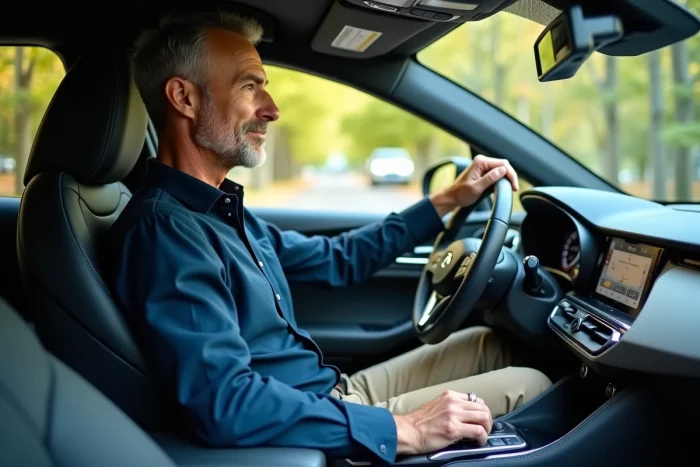
Some car manufacturers require the activation of mode B to maximize energy recovery during braking, while others limit this feature to specific situations. The use of mode D, which is the default on most electric and hybrid vehicles, does not always offer the same efficiency depending on the driving profile and the terrain encountered.
The switch between these two modes is not intuitive and can even lead to overconsumption if not properly managed. Several manufacturers recommend alternating based on the road environment, without providing universal guidelines.
Mode B or D: what differences for your daily driving?
Inside an electric or hybrid car, the markers change. Mode B, mode D: behind these two innocuous letters lie very different approaches to each journey, and above all, a new way of thinking about energy consumption.
The D mode is activated by default. It promises a smooth, uninterrupted drive, reminiscent of what we know from traditional automatic transmissions. As soon as you release the accelerator, the car maintains its momentum without stopping too quickly, limiting the effect of engine braking. On the highway or long roads, this mode works wonders: it calms the driving experience, reduces the need to use the brake pedal, and adapts perfectly to the regularity of trips.
The B mode, on the other hand, changes the game. As soon as the foot is lifted, deceleration is immediate: engine braking is felt, the battery recovers energy, and the mechanical brakes work much less. This mode is essential when managing numerous slowdowns: in the city, on sloped routes, or whenever stops multiply. The management of the accelerator then becomes more nuanced, more attentive, almost strategic to make the most of each deceleration.
Driving in mode B or D requires integrating these nuances to adjust habits. Some rely on B mode to save battery in the city, while others prefer the continuity of D mode to cover distances smoothly. This choice is no longer just a matter of comfort: it reflects a true energy management strategy, tailored to each context.
In what situations does mode B really make a difference?
Urban driving imposes its own rhythm: stops, restarts, choppy flow. In this constant ballet, B mode stands out. With its enhanced regenerative braking, every slowdown becomes an opportunity to recover energy, raise the battery level, and preserve the mechanical brakes.
On hilly roads or downhill, B mode takes on another dimension. Here, the car slows down without touching the brake, while recharging the battery. This precise control improves safety, reduces overheating, and turns every elevation change into an ally rather than an obstacle.
Of course, there are some limitations: in cold weather or if the battery is already well charged, recovery may be less effective. But for the vast majority of urban trips, B mode remains a remarkable asset for combining eco-driving and regained autonomy.
Here are some situations where B mode stands out:
- In the city, managing frequent stops becomes a natural reflex.
- On descents, regenerative braking takes over from traditional brakes.
- By anticipating each slowdown, lost energy is transformed into additional kilometers.
When used wisely, B mode reveals its full potential as soon as you encounter traffic lights, curves, or marked elevations. It transforms driving into true energy management, and that is its main benefit.

Practical tips for choosing the appropriate mode based on your trips
Adapting the driving mode to the environment is essential for fully enjoying your electric or hybrid car. In the city, B mode becomes a reflex. The density, stops, and the need to anticipate each slowdown all encourage the use of regenerative braking and the preservation of brakes.
As soon as the road opens up or you join the highway, D mode regains its advantages. It promotes fluidity, stabilized speed, limits unnecessary engine braking requests, and allows for optimized autonomy over long distances.
Also consider external conditions: in cold weather, energy recovery in B mode may decrease. On a hilly road, switch to B mode occasionally to save your brake pedal and enjoy a battery recharge surplus.
Depending on the situations encountered, here’s how to guide your choice:
- In dense urban areas, B mode is essential to maximize every slowdown.
- On open roads or highways, D mode allows for better control of consumption.
- For a mixed journey, alternate based on the topography and your driving style.
The key is to be attentive to your driving style: anticipation, eco-driving, and flexibility are the best allies to make the most of each mode. Ultimately, efficiency lies in these subtle choices, far from automatism, closely aligned with the road and the realities of daily life.